Part I
The Access Problem
A tool priced like a building becomes a building: it gets a room, a schedule, a queue, and an operator. Then the price of computing collapsed, and an engineer in Hobart wrote his own tool.

Crown Jewel Press · Published 3 November 2026
The Unfinished Search for a Unified Design Workflow
Tools for electronics got better. The workflow never became whole.
Paperback and Kindle published 3 November 2026. Jacketed hardcover scheduled for 3 December 2026.
A practitioner’s history of how electronic design tools moved closer to the engineer, and why the larger search for a unified design workflow remains unfinished.
By D. K. Singh
Out now in paperback and Kindle. The jacketed hardcover is scheduled for 3 December 2026.
The premise
A schematic says one thing. The board says another. In the author’s first job the two belonged to different people: the engineers explained what the circuit had to do, a draftsman turned the explanation into a board, and the work moved through a relay: marked-up schematics, notes, an engineer sitting beside the layout station because a drawing alone did not carry everything he meant. The tools got better. The relay did not disappear; it moved. A board project today knows the microcontroller at its center as a footprint, a symbol and a bill-of-materials line, not as the firmware that will run on it; the requirement the product had to meet (hill-start torque, range, a thermal limit at the end of a summer climb) lives upstream, in documents, spreadsheets and meetings. Every domain has excellent tools. The reasoning that connects them still lives in people.
It exposes the connective layer the book calls the missing center: the one nobody owned, and therefore nobody’s strategy.
Harvesting the Crown Jewel tells the four-decade story of the people who came closest. Nick Martin saw a CAD world that was expensive, centralized, and guarded, and put serious PCB design on the working engineer’s own desk. The story widens from Protel and Altium to Cadence, Mentor and Siemens, cloud collaboration, and the moment a maker of the components themselves bought a major board-level design workflow.
Part technology history, part business story, part firsthand engineering narrative, written by someone with twenty-five years of experience across engineering and the semiconductor industry.
Beyond the software
One part of that journey did become continuous. The integrated board environment that began as Protel, and became Altium Designer, held schematic intent and physical implementation in one working grip. For many engineers it was the first time continuity of intent was felt anywhere in the journey, and an engineer who has felt that once begins to expect it everywhere else.
Around that environment an industry’s memory accumulated: the trusted library, the inherited design, the production history, the instinct in the hands. None of it appears on a feature chart, and none of it can be relocated intact. From the engineer’s side it is capital; from the company’s side it is a moat. That environment, and the engineering memory accumulated within it, are the crown jewel of the title.
The arc
Part I
A tool priced like a building becomes a building: it gets a room, a schedule, a queue, and an operator. Then the price of computing collapsed, and an engineer in Hobart wrote his own tool.
Part II
What accumulates inside a design environment: the trusted library, the inherited design, the production history, the fluency in the hands. Memory is the asset you measure by losing it.
Part III
Two documents from 1999 show a company claiming far more than the market was ready to buy. The destination had logic. The schedule did not.
Part IV
A founder terminated in six contested weeks, a direction that outlived him, and a second lane that had left the company in 2000 and quietly come back.
Part V
Accumulated trust becomes recurring revenue becomes acquisition capacity. The engineer’s capital and the vendor’s moat turn out to be one asset seen from two sides.
Part VI
The cloud arrives around the desktop, silicon buys the workflow, and the reasoning of the whole product still has nowhere to live.
Coda
The same standard applied to the incumbent the Western acquisition story usually leaves out.
Ideas from the book
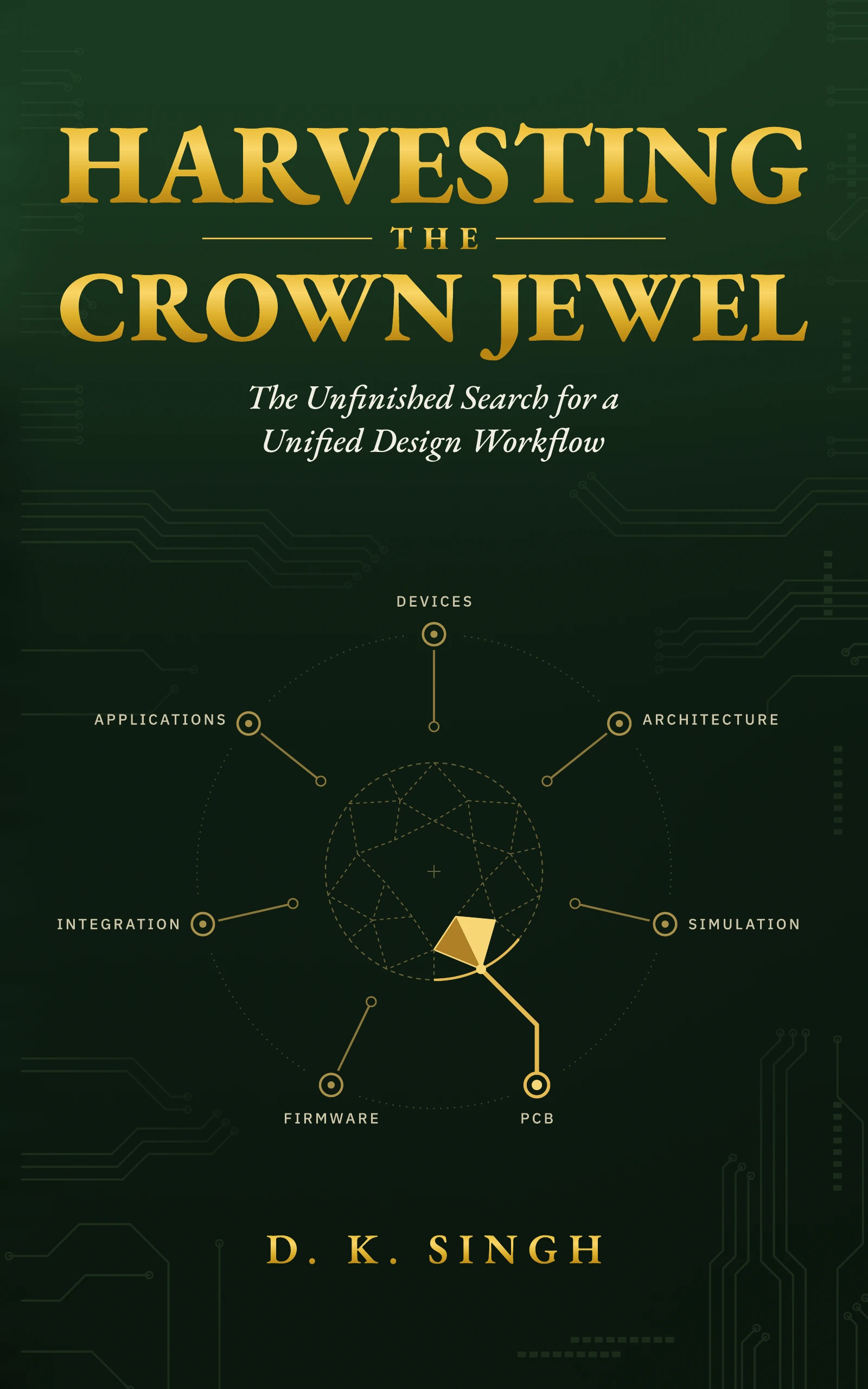
Devices, architecture, simulation, PCB, firmware, integration and applications: seven layers of embedded electronics, each with its own tools, all pointing at a center nobody owns. On the cover only one facet is cut: the board, the one layer that became continuous.
The connective layer nobody owned, and why corporate boards fund extensions of strength, not expeditions from empty ground.
What any owner of a unified workflow must deliver, stated in Chapter 15.
Ownership and neutrality tests the author applies to his own employer, and, in the Coda, to Renesas’ Japanese competitor Zuken by the same ruler.
The present-day test
The board workflow is not the whole product. Silicon, firmware, mechanical, sourcing, validation and manufacturing kept their own tools, and the account of a product’s intent across all of them stayed where it had always been: in people. In February 2024 Renesas Electronics agreed to acquire Altium, and the purchase completed on 1 August 2024. The combination placed silicon, embedded software, the board workflow, a cloud layer and component intelligence under one owner.
The book treats that combination as an open test, not an answer. Chapter 14 sets five tests of ownership and neutrality. As of mid-2026, the public record supported neither a pass nor a fail on any test. The Coda applies the same standard to Zuken; its verdict remains partial and ungraded.
Advance praise
“Every engineer knows the frustration of changing one requirement and discovering how many things suddenly stop working together. We’ve spent decades building better tools, yet somehow this problem never really goes away. DK understands why. …”
Fabio ViolanteFormer CEO of Arduino
“A definitive record of how electronics design tools moved closer to the engineer, while the larger issue of coherent product intent stayed just out of reach. Required reading for anyone who builds, buys, or depends on the tools that turn silicon into systems.”
Robert LucasVice President, High Performance Computing, Monolithic Power Systems
“A practical and engaging exploration of the distance between a technically correct design and a complete, manufacturable product. Engineers and engineering managers will recognize many of these challenges immediately.”
Andreas HammerSenior Vice President Global Sales at YAGEO Group
“Part candid history of Desktop EDA, part insider account of modern tech centralization, Harvesting the Crown Jewel captures the evolution of hardware design with remarkable rigor and nuance. …”
Sailesh Chittipeddi, PhDVenture Partner, NovoTellus Capital; Former President Renesas Electronics America
“Good product development starts with a real problem and the customer we are solving it for. Harvesting the Crown Jewel shows how easily that original intent can become fragmented as a product moves through architecture, specialized engineering disciplines, and implementation. It is a reminder that successful product development ultimately requires keeping sight of why we are building it in the first place.”
Rufino Olay IIITechnology Executive & Engineering Educator; Adjunct Faculty, San José State University
“This book uses the history of CAE tools as a backdrop to deeply reflect on real end-user needs, and what is still missing to reach the holy grail of a unified design suite capable of preserving all the know-how behind a project.”
Dario PennisiCTO, FAE Technology
“It is a fascinating account of a System Designer witnessing the evolution of PCB solution ecosystem and its manifestation in various corporate avatars to address the technical challenges on the ground. It is fast paced, carries the reader along effortlessly.”
Sridhar JoshiCEO, TenXer Labs
“While individual engineering teams and tools excel, creating a unified development workflow across domains remains one of the industry’s toughest challenges. D. K. Singh tackles this head-on with an unusual blend of technical depth, customer insight, and executive vision …”
Amit KumarVice President and Business Unit Head, Schneider Electric India Private Limited
“Having known DK for several years, I still find this worldly, sophisticated manager full of surprises. This book is not only about the history of electronics and choosing the best tools, but also about where good ideas come from and how to execute them. While skillset, attitude and timing are all important, DK’s differentiator is his personal vision for shaping the future of the electronic industry.”
Dr. Christian MeyerSenior Manager Application, SGX Sensortech
“The most difficult transformations are rarely limited by technology alone. They require leaders to connect organizations, incentives, knowledge, and customer needs around a shared vision. Harvesting the Crown Jewel makes that case with clarity and conviction.”
Maruti Eknath ChavanSenior Vice President, Information Technology, Axis Bank
“An unusually clear view of the gap between designing a circuit and realizing a complete, manufacturable system. Essential reading for anyone shaping the future of engineering workflows. …”
B. S. ChakravarthyCEO, DTDS Technology Pte Limited, Singapore
“… It explores why the electronics industry has successfully unified PCB design but still struggles to achieve a seamless, end-to-end electronics system design workflow. It traces decades of efforts from early EDA tools to modern platforms …”
Donald ParkmanRetired Semiconductor Marketing Executive
About the author

DISCLOSURE: I wrote this book in my personal capacity. It was not commissioned, sponsored, or endorsed by Renesas, Altium, or any other company. At the time of writing, I was Vice President, Digitalization Division, at Renesas Electronics. The views are mine.
D. K. Singh has spent twenty-five years inside the electronics industry: first as a system design engineer in India and Japan (Onida in India, then JVC in Japan, thirteen years in Japan in all), then in semiconductor product management in Silicon Valley from 2013. He studied at IIT (BHU) and grew up in Patna, Bihar.
San Jose · Yokohama · Patna
Explore DK’s journey →On evidence. Every claim about a company rests on the cited public record (filings, announcements, product documentation), with 28 pages of notes to say where. On memory. Where the author draws on what he saw at the bench or in the boardroom, the text says so, and keeps it apart from the record. On verdicts. The acquisition is treated as a test. Chapter 14 sets five tests of ownership and neutrality for the Renesas-Altium combination. As of mid-2026, the public record supported neither a pass nor a fail on any test. The Coda holds Zuken to the same standard, and its verdict is partial and ungraded.
Editions
$44.99
ISBN 979-8-9969199-5-6
Scheduled for 3 December 2026
$24.99
ISBN 979-8-9969199-1-8
On sale now
$9.99
₹399 in India
ISBN 979-8-9969199-6-3
On sale now
218 pages · 6 × 9 in · Crown Jewel Press · First edition, 3 November 2026.
Universities, libraries, and teams: Ask about bulk and institutional orders
An India print edition is in preparation.
The Seven Obligations
Chapter 15 sets out the Seven Obligations that anyone who claims to own a unified design workflow has to meet.
A free Reader's Guide to the Seven Obligations goes up here on 17 November 2026.